The pace of change has finally outrun the supply chain playbook. What once felt like volatility now feels like the natural rhythm of global commerce – a rhythm that’s triggering an extraordinary evolution.
Planning cycles are compressing. Decisions are becoming fluid and adaptive. Technology is stepping into the role of strategic partner rather than a silent enabler. And the supply chain itself is emerging as one of the most powerful engines of enterprise value.
The signals for 2026 are unmistakable. Gartner highlights the rise of agentic AI, intelligent simulation, and next-generation workforce tools as forces reshaping how supply chains behave. Deloitte sees digital twins becoming essential decision infrastructure, unlocking efficiency, sustainability, and resilience at scales once considered out of reach.
Together, these advancements signal a redefinition of how the supply chain creates value. With a fundamentally new operating model grounded in embedded intelligence and orchestrated decision-making, supply chain organizations now have the opportunity to shape enterprise strategy rather than simply support it.
Below are the trends defining this new era and what they mean for supply chain leaders.
Trend 1: AI-Driven Decision Intelligence Becomes Core
For years, AI promised insights. Now it’s delivering something far more valuable: decisions that are faster, clearer, and more connected to business intent.
Decision intelligence is rising because organizations want to break free from reacting to yesterday’s demands, constraints, and surprises. Leaders want foresight grounded in evidence and ready for action.
Gartner frames this level of decision intelligence as a fusion of analytics, AI, and decision modeling that elevates and automates choice-making across the enterprise. In practice, it reflects the progression of planning into a forward-looking, strategic discipline.
As Scott Tillman, VP of Innovation, explains, “Decision intelligence transforms planning from reconciliation and hindsight to confident decisions that influence the future.”
This advancement reflects a reorientation in how teams work, spending less time managing data and more time exploring scenarios, negotiating trade-offs, and steering strategy. In decision-intelligent environments, planners add more value through judgment, creativity, and informed direction.
Trend 2: Agentic AI and Autonomous Supply Chain Agents Take Center Stage
One of the most influential technological changes is the emergence of agentic AI – systems that operate like autonomous collaborators capable of reasoning, planning, and acting on the organization’s behalf.
Instead of merely flagging problems, agents can diagnose disruptions, forecast outcomes, evaluate alternatives, and initiate corrective action. Responsiveness collapses from days to hours, minutes, and eventually seconds.
Jason DeVine, VP of Engineering Operations, explains, “Agents aren’t here to replace planners. They’re here to handle the thousands of micro-decisions that get in the way of the big ones.”
Early adopters are already experiencing a reimagining of the planner’s role. As intelligent agents perform procedural tasks, humans step into more strategic territory of scenario design, cross-functional alignment, and long-range orchestration. Scaling these capabilities becomes dramatically more seamless as composable architectures mature.
Trend 3: Human–AI Collaboration Redefines the Augmented Workforce
The rise of the augmented connected workforce points to a fundamental transformation in how supply chain teams get work done. This movement is not about AI replacing talent but about removing the friction that has long prevented people from contributing at their highest level.
Reconciliation, spreadsheet wrestling, and exception-chasing give way to analysis, strategy, and collaborative decision-making. Teams have stopped drowning in data and started interpreting it, challenging it, and using it to craft action.
Organizations embracing this progression – including those operating in decision-intelligent environments such as those running on Logility’s platform – report a rise in confidence, alignment, and strategic clarity. Meetings become forward-looking. Insights flow more freely. Decisions happen with greater certainty and cohesion. Teams feel more empowered and more connected to enterprise strategy.
This isn’t automation. It’s amplification.
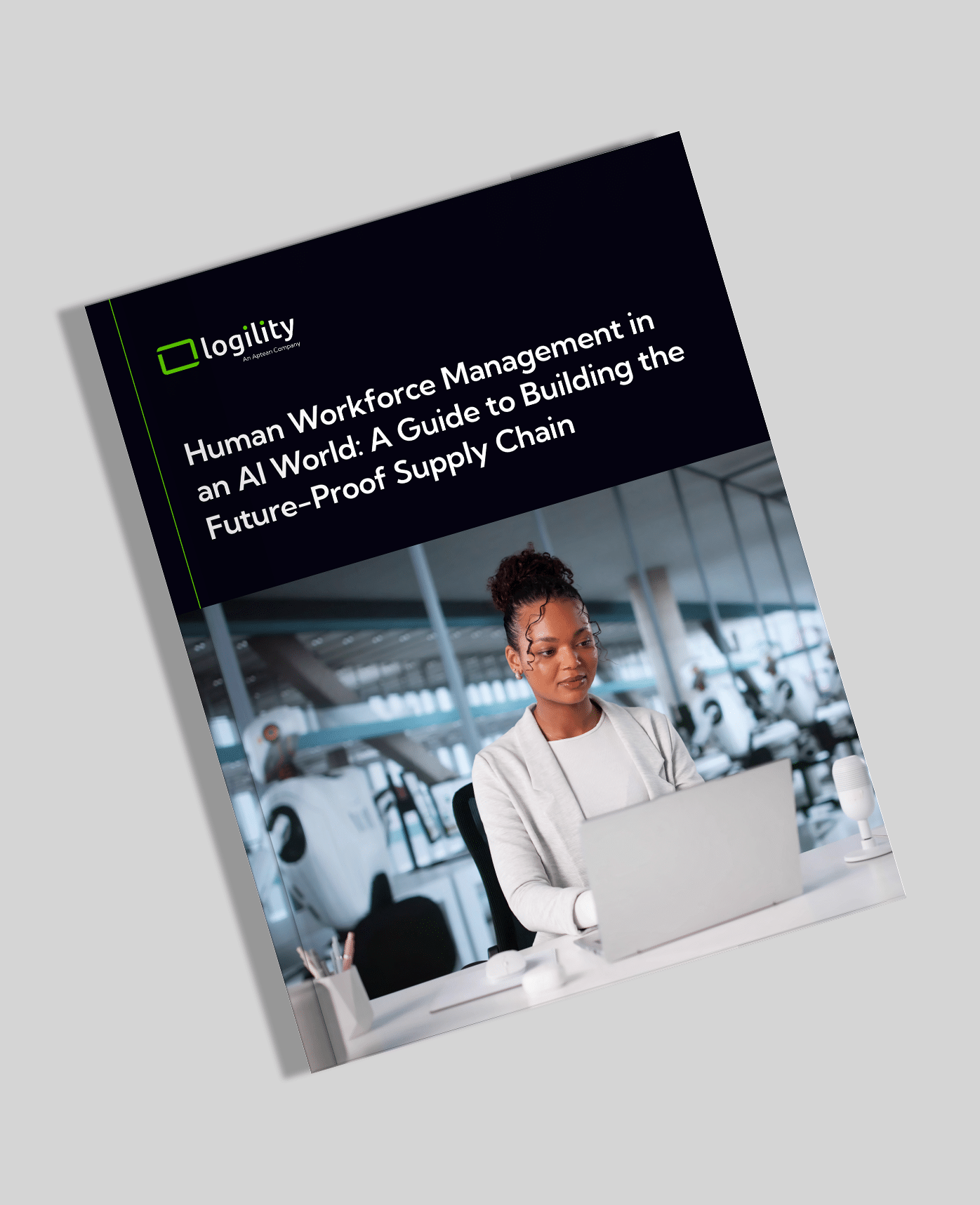
Guide: Human Workforce Management in an AI World
Want to know more about the future of the supply chain workforce? Inside, you’ll learn how to empower your teams with AI-driven insights, reskill talent for higher-value roles, and build collaborative, cross-functional units that thrive in disruption.
DownloadTrend 4: Resilience Emerges Through Modular and Composable Architectures
As volatility accelerates, the limitations of monolithic systems become impossible to ignore. Supply chain organizations are increasingly focused on technologies that enhance connectivity and intelligence, mirroring a broader migration toward composable architectures.
Continuously evolving, composable environments let organizations introduce new capabilities without disrupting existing applications, processes, and workflows. Instead of undergoing massive system overhauls, companies can layer intelligence precisely where it is needed — from autonomous agents and simulation engines to sustainability insights, risk analytics, and IoT-derived signals.
“Composable architectures let companies add intelligence without breaking what already works,” observes DeVine. “This adaptability is becoming a competitive hallmark.”
Organizations that adopt modular, future-ready platforms innovate faster, integrate more fluidly, and respond more effectively than those tied to rigid legacy environments. In an era defined by unpredictability, adaptability becomes a key advantage.
Trend 5: Supply Chain Digital Twins Are Scaling Up
Digital twins have quickly advanced from an emerging possibility to a foundational capability. Deloitte positions them as strategic decision infrastructure, with the power to improve operational efficiency by double digits and significantly reduce emissions and downtime.
A digital twin is a dynamic, learning replica of the supply chain. It enables leaders to simulate disruptions, test constraints, explore scenarios, and understand ripple effects before committing resources. In a world where disruptions cascade instantly, such foresight becomes indispensable.
“Digital twins generate their greatest value when paired with decision intelligence,” notes Tillman. “By transforming raw insights into orchestrated, end-to-end action, they allow companies to practice the future before they have to live it.”
Organizations deploying digital twins are not only optimizing performance; they are gaining the ability to make more confident decisions in an environment where certainty is increasingly rare.
A New Operating Model for Your New Era
Across all these developments, one truth stands out: supply chains must evolve into intelligent engines that actively shape the world around them. The companies that thrive in this next era will be those that treat the supply chain as a strategic design space, not an operational necessity.
Leaders who excel in 2026 and beyond will:
- Turn decision intelligence into a daily discipline
- Use autonomous agents to scale capability and precision
- Elevate the workforce through human–AI partnership
- Build architectures that can evolve as quickly as the market
- Leverage digital twins to test future scenarios before committing to them
Because the future won’t reward adaptation alone – it will reward the companies that think intelligently, decide boldly, and act ahead of the curve.